
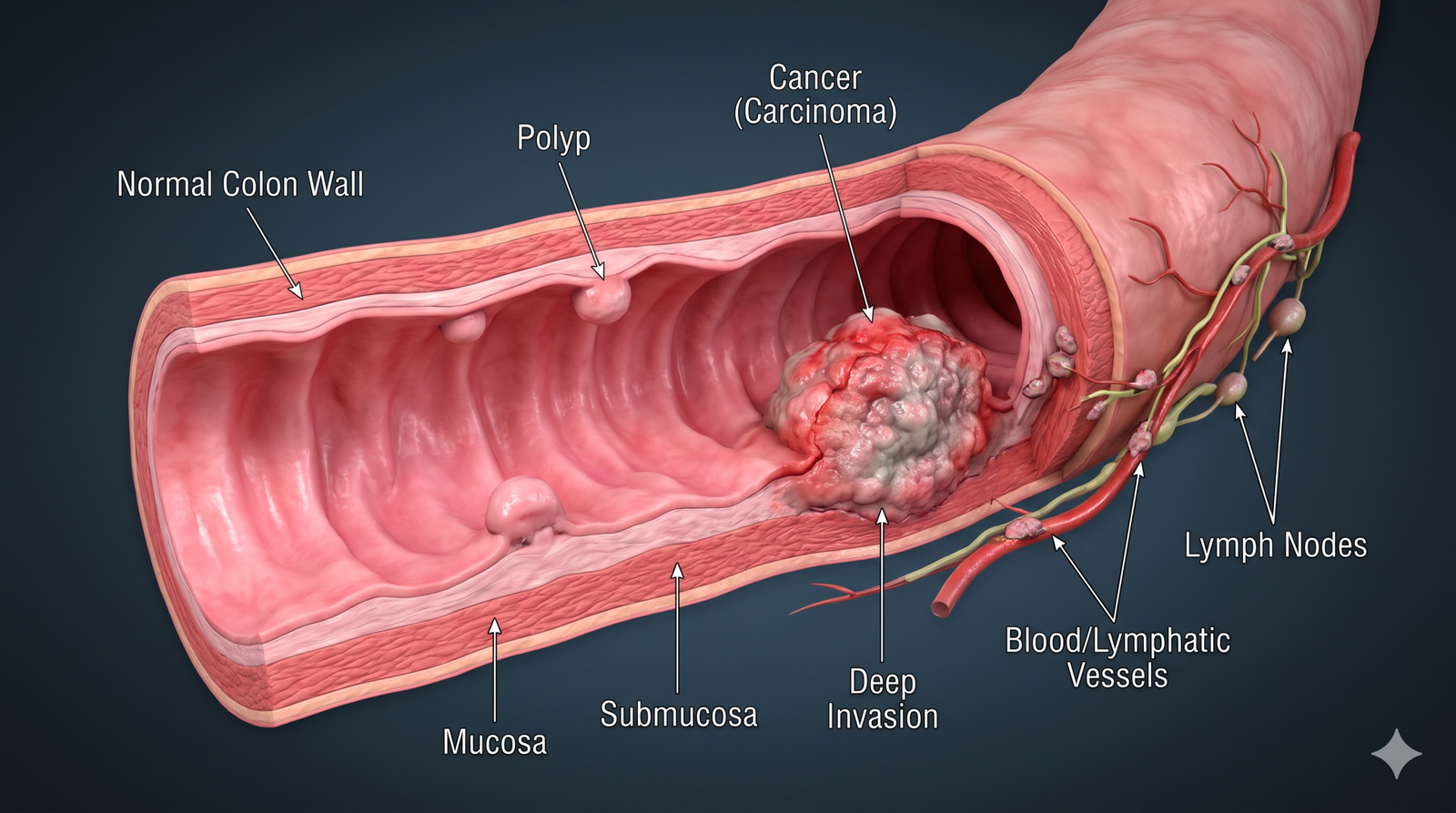
Colon cancer is a type of cancer that develops in the large intestine (colon), usually beginning in its inner lining and often developing from precancerous growths called polyps. It is a major health concern worldwide due to its rising incidence and mortality. GLOBOCAN 2022 reported approximately 1.14 million new cases of colon cancer and 538,167 deaths globally. When combined (colorectal cancer), colon and rectal cancers are the third most commonly diagnosed cancer and the second leading cause of cancer-related deaths in the world, with about 1.9 million new cases diagnosed each year.
The risk of developing colon cancer increases with age, family history, genetic conditions, obesity, physical inactivity, smoking, alcohol consumption and diets high in red and processed meat. Although it is more common in older adults, cases among younger individuals are also increasing in several countries.
Step-by-Step Guide to Colon Cancer Diagnosis: Tests & Scans Explained
Diagnosing colon cancer follows a structured, step-by-step clinical pathway designed to first locate suspicious growths, confirm whether they are malignant at a cellular level, and determine if the disease has spread elsewhere in the body.
1) Colonoscopy: Direct Visualisation
A colonoscopy is the gold standard in evaluating the entire inner lining (mucosa) of the large intestine and rectum. After the bowel is cleaned out, the doctor inserts a thin, flexible tube with a high-definition camera and light source (colonoscope) through the rectum into the beginning of the colon. While visual inspection is not definitive for cancer, it does enable doctors to directly view the surface of the tissue and get immediately to the abnormal areas.
A) Polyps: These are small, benign-appearing growths (like adenomas) that can become cancerous over time and are usually removed in their entirety at the same session (polypectomy).
B) Suspicious Masses or Ulcers: Irregular growths, bleeding sores, or narrowed segments (strictures) that partially block the bowel.

2) Biopsy & Histopathology: Definitive Confirmation
A biopsy is the only test that confirms a colon cancer diagnosis with certainty. During the colonoscopy, tiny instruments passed through the scope pinch off small tissue samples from any suspicious growth, which are then sent to a pathology laboratory for microscopic and genetic evaluation.
A) Malignancy & Subtype: A pathologist confirms whether cells are benign, precancerous, or invasive cancer, and identifies the cell type—over 90% of colon cancers are adenocarcinomas arising from mucus-producing glandular cells.
B) Tumor Grade: Evaluates how abnormal the cancer cells look under a microscope (low-grade vs. high-grade) to estimate how rapidly the tumor may grow.
C) Biomarker & Molecular Profiling: Tests the tissue for key genetic features—such as MSI-H/dMMR (microsatellite instability) and KRAS, NRAS, or BRAF mutations—which guide eligibility for targeted therapies and immunotherapy.
3) PET-CT Scan: Whole-Body Staging
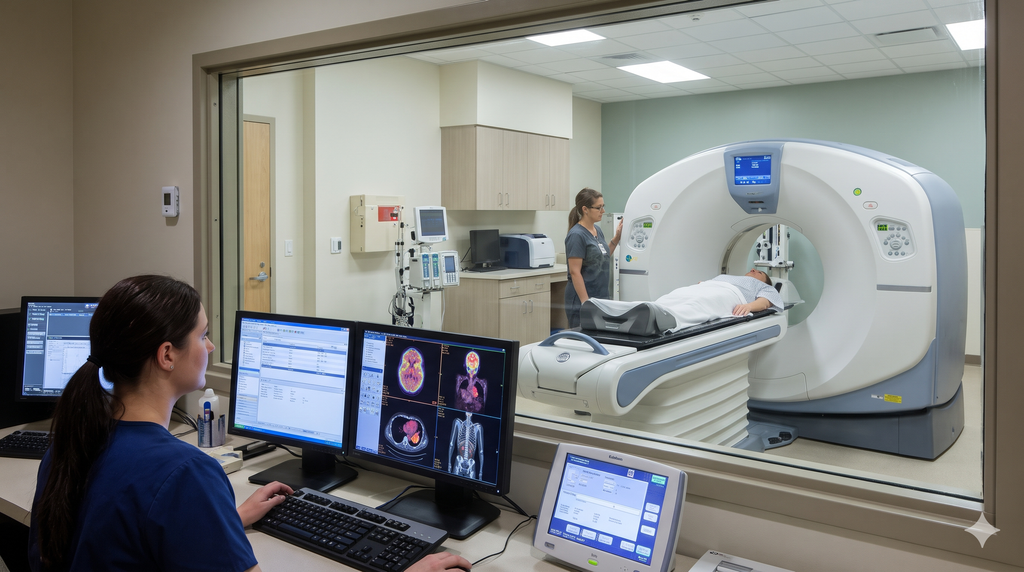
Once a biopsy confirms colon cancer, imaging is required to stage the disease and check whether cancer cells have spread (metastasized) to nearby lymph nodes or distant organs like the liver, lungs, or abdominal lining (peritoneum). A PET-CT merges two distinct scanning technologies into a single machine to provide both functional and structural clarity.
A) PET (Positron Emission Tomography): It uses a safe, radioactive glucose tracer (18F-FDG) injected into a vein; because rapidly dividing cancer cells consume more sugar than healthy cells, they light up as bright metabolic “hot spots.”
B) CT (Computed Tomography): It captures detailed cross-sectional X-ray images that pinpoint the exact anatomical size, shape, and location of those hypermetabolic areas.
4) Supporting Blood Tests
Alongside endoscopy and imaging, routine blood panels provide essential baseline data for treatment planning and ongoing monitoring.
A) CEA (Carcinoembryonic Antigen): A protein tumour marker measured before treatment begins; tracking whether CEA drops after surgery or rises later helps doctors monitor treatment response and detect potential recurrence.
Dr. Ravi Gupta – Ayurvedic Doctor for Colon Cancer Treatment
Dr. Ravi Gupta, M.D. (Ayurveda), is an Ayurveda Cancer Consultant with 12+ years of Oncology experience, specialising in Ayurvedic oncology, Panchakarma and Rasayana therapy. He provides individualised Ayurvedic treatment plans for patients diagnosed with colon cancer, focusing on Ayurvedic treatment, dietary management, lifestyle modifications and integrative cancer care.
Patients from Maharashtra, Gujarat, Rajasthan and Uttar Pradesh can contact Dr. Ravi Gupta for consultation regarding Ayurvedic treatment and supportive care for colon cancer.
Contact Dr. Ravi Gupta
Phone / WhatsApp: +91-98192 74611
Email: cancerinayurveda@gmail.com
Website: www.cancerinayurveda.com
Clinic Locations: Maharashtra | Gujarat | Rajasthan | Uttar Pradesh; and Worldwide