

Breast cancer remains the most common cancer among women in the United States and is a major public health problem. Better screening, earlier detection, surgery, chemotherapy, radiation therapy, hormone therapy and targeted treatment have all improved survival rates. Today, millions of women in the U.S. are breast cancer survivors. But even if treatment is successful, some patients may have to deal with the problem of breast cancer recurrence.
Breast cancer recurrence is when the disease returns after a time period in which no cancer was detected. Recurrence may be local in the breast or chest wall, regional in nearby lymph nodes, or distant, such as in the bones, lungs, liver, or brain. Risk of recurrence is determined by several factors including stage of cancer at diagnosis, biology of the tumor, lymph node involvement, hormone receptor status and compliance to recommended treatments.
Breast Cancer Recurrence in Survivors: Ayurvedic Understanding and Its Consequences
As per Ayurveda if a malignant growth is not completely removed or excised, it may reappear and become more aggressive. Classical Ayurvedic texts emphasize that residual disease can lead to Punarbhava (reoccurrence), which parallels the modern understanding that microscopic residual cancer cells left behind after treatment can contribute to local recurrence or distant metastasis. Studies in modern oncology has well demonstrated that positive surgical margins and residual malignant cells can significantly increase the risk of disease recurrence.
How Breast Cancer Recurrence Can Affect Survivors
1) Disease Progression: Breast cancer may return in the breast area, nearby lymph nodes, or other organs such as the bones, lungs, liver, or brain. Advanced recurrence can be more difficult to treat.
2) Emotional Impact: Many breasts cancer survivors experience fear, anxiety, stress, or depression related to the possibility of cancer returning.
3) Impact on Long-Term Health: Recurrent or metastatic breast cancer can affect long-term survival, making ongoing follow-up care and healthy lifestyle practices especially important.
Integrative Ayurvedic Management of Breast Cancer Recurrence
The treatment for recurrent breast cancer depends on where it recurs (local, regional, or distant/metastatic), the previous treatment received, hormone receptor status, HER2 status, overall health, and patient preference. Management is usually multidisciplinary with surgery, radiation oncology, medical oncology and supportive care specialists.
Ayurveda can play a valuable integrative and supportive role in the management of breast cancer recurrence when used alongside conventional oncological treatments. Timely and early Ayurvedic interventions can help to achieve better results, improve quality of life, support recovery, and further it can even address treatment-related side-effects. Ayurvedic interventions that prove beneficial in recurrent breast cancer are:
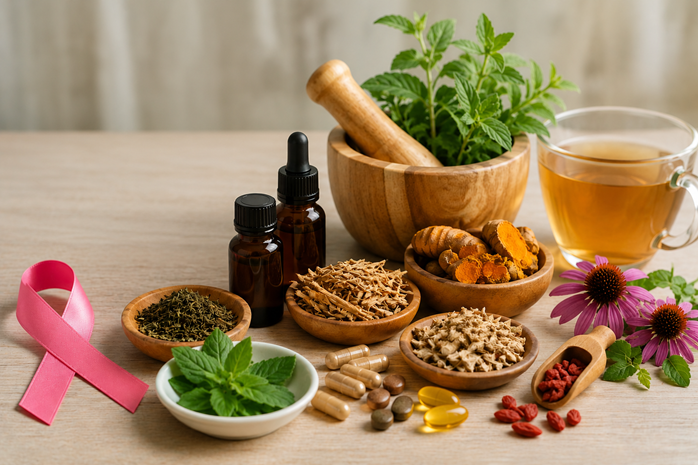
1) Herbal Medicines in the management of Recurrent Breast Cancer
Herbal medicines can play an important role in the integrative management of recurrent breast cancer by helping in achieving better results, supporting immune function, reducing treatment-related side effects, and promoting overall well-being. These interventions should be used under the guidance of qualified healthcare professionals.
a) Guduchi (Tinospora cordifolia)
Guduchi is a renowned Rasayana herb known for its immunomodulatory, antioxidant, and adaptogenic properties. It is traditionally used to enhance vitality, support immune health, and improve resilience in breast cancer patients.
b) Haridra (Turmeric, Curcuma longa)
Turmeric contains curcumin, a bioactive compound that has demonstrated anti-inflammatory, antioxidant, and potential anticancer activities in preclinical studies. Curcumin has been extensively investigated for its role in breast cancer biology and treatment.
c) Manjistha (Rubia cordifolia)
Manjistha is traditionally used for maintaining healthy circulation and supporting normal lymphatic function. It is often included in Ayurvedic formulations aimed at promoting tissue health and detoxification.
d) Neem (Azadirachta indica)
Neem possesses antioxidant and immunomodulatory properties and has been investigated for various biological activities.
2) Panchakarma Therapy in the management of Recurrent Breast Cancer
Panchakarma is a specialized detoxification and rejuvenation therapy in Ayurveda that aims to restore balance among the Doshas, improve tissue metabolism, eliminate accumulated toxins (Ama), and enhance the body’s natural healing capacity. According to Ayurvedic principles, recurrent breast cancer may be associated with persistent Dosha imbalance, accumulation of Ama, impaired Agni (digestive and metabolic fire), and dysfunction of the Rasa, Rakta, and Mamsa Dhatus.
Potential Roles of Panchakarma in Recurrent Breast Cancer:
a) Detoxification and Metabolic Correction
It helps to eliminate accumulated metabolic toxins (Ama), and further supports digestive and tissue metabolism.
b) Immune and Tissue Support
Panchakarma can also prove beneficial for Rasayana therapy, which aims to strengthen immunity, enhance tissue nourishment, and promote recovery.

3) Rasayana Therapy in the management of Recurrent Breast Cancer
Rasayana Therapy is one of the most important branches of Ayurveda, focused on rejuvenation, tissue nourishment, enhancement of immunity (Vyadhikshamatva), and promotion of longevity and overall well-being. Rasayana therapy can play an important role as part of an integrative oncology approach by helping improve physical strength, reduce treatment-related side effects, enhance quality of life, and support recovery during and after conventional cancer treatments.
Potential Roles of Rasayana Therapy in Recurrent Breast Cancer:
a) Enhancing Immunity and Host Defense
Rasayana medicines are traditionally believed to improve the body’s natural defense mechanisms. Strong immune system helps to cope with recurrent breast cancer more efficiently.
b) Supporting Tissue Nourishment
Rasayana helps to nourish all body tissues, particularly Rasa, Rakta, Mamsa, and Ojas, which are often affected in chronic illnesses such as cancer.
c) Promoting Healthy Aging and Recovery
Rasayana therapy helps to contribute to improved vitality and overall wellness during survivorship.

Dr. Ravi Gupta, Ayurveda Cancer Consultant
📞 Call / WhatsApp: +91 98192 74611
📧 Email: cancerinayurveda@gmail.com
💻 Online Consultations Available for Patients Across the USA To learn more or schedule a consultation, contact Dr. Ravi Gupta, Ayurveda Cancer Consultant today.