
A Case of Lung Adenocarcinoma Managed with Ayurveda, Rasayana Therapy and Modern Cancer Treatment
Lung cancer is one of the most challenging cancers to manage, particularly in elderly patients and in cases involving molecular alterations such as EGFR mutations. Ayurveda should be explored in such cases and treatment should be aimed treating the lung cancer, maintaining strength, supporting quality of life and helping the patients remain functionally active.
This case study describes the clinical journey of a 75-year-old male diagnosed with moderately differentiated adenocarcinoma of the left lung, who was subsequently managed with modern oncology treatment along with an Ayurvedic approach under the guidance of Dr. Ravi Gupta, Ayurveda Cancer Consultant and Panchakarma Specialist.
The case demonstrates the importance of regular imaging, molecular profiling, individualized treatment and ayurvedic care in the long-term management of lung cancer.
Patient Profile
Age: 75 years
Sex: Male
Diagnosis: Moderately differentiated adenocarcinoma of the left lung
Smoking history: Approximately 20–30 years
Initial conventional treatment: Pembrolizumab + Carboplatin
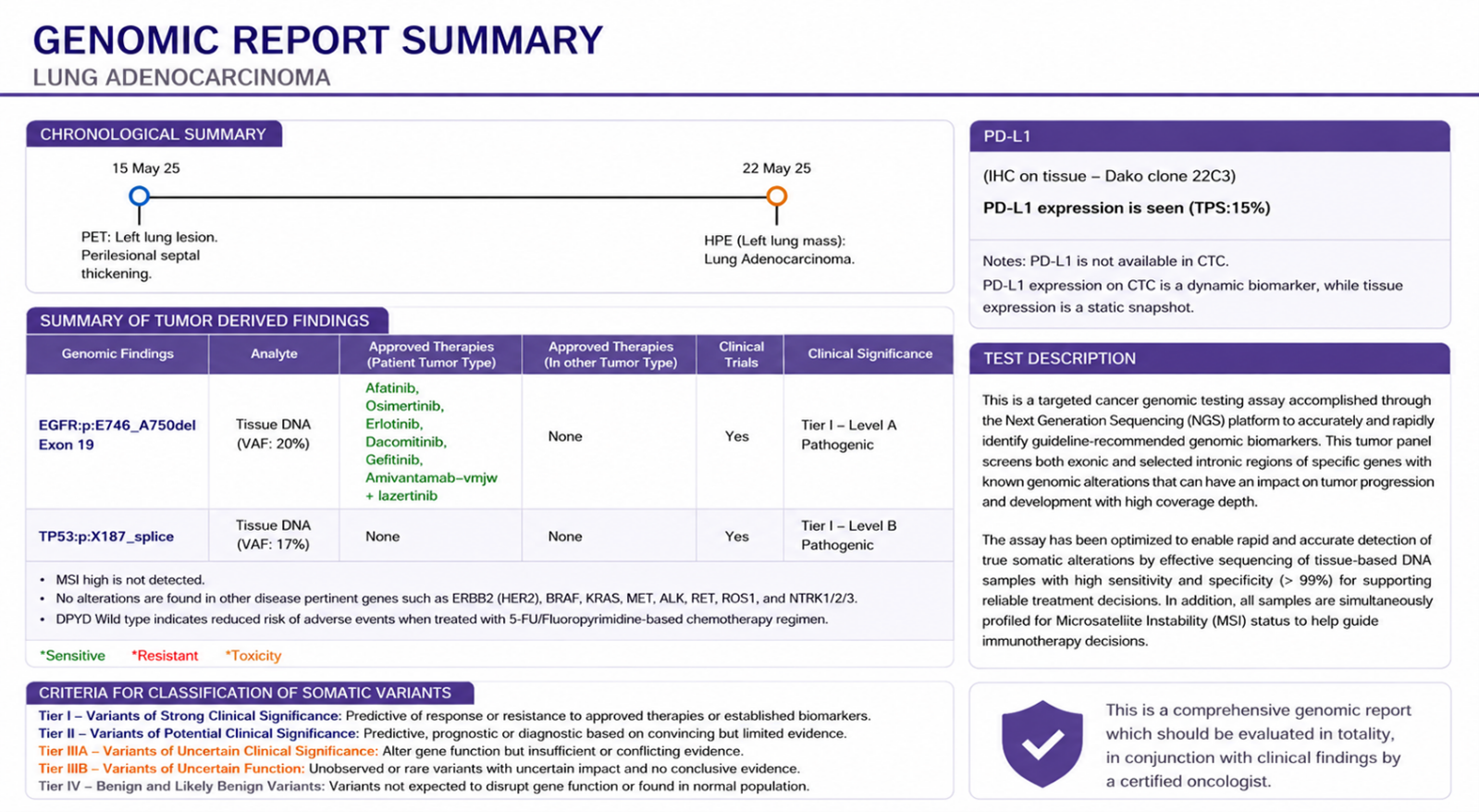
Molecular finding: EGFR exon 19 deletion
PD-L1: TPS 15%
Ayurvedic approach: Herbal medicines, Rasayana Therapy and Balya Therapy
Follow-up: Serial PET-CT evaluation
The patient came under follow-up in May 2025 after being diagnosed with lung adenocarcinoma. At that stage, he had already received the first cycle of Pembrolizumab and Carboplatin.
Diagnosis of Lung Adenocarcinoma (06.06.2025)
Histopathological examination of the lung biopsy demonstrated tumor cells arranged predominantly in sheets and islands, with focal gland formation. The cells showed pleomorphic nuclei and abundant eosinophilic cytoplasm. Moderate lymphocytic infiltration, anthracotic pigment and areas of necrosis were also reported.
Immunohistochemistry demonstrated:
a) CK7 positive
b) TTF-1 positive
c) p40 negative
The findings supported the diagnosis of moderately differentiated lung adenocarcinoma. Lung adenocarcinoma is a major form of non-small cell lung cancer (NSCLC).
Molecular Testing and EGFR Mutation (17.06.2026)
Targeted next-generation sequencing identified a clinically significant EGFR exon 19 deletion, p.E746_A750del, with a variant allele frequency of 20%.
The alteration was classified as Pathogenic, Tier I–Level A. The molecular report listed several approved targeted treatment options for EGFR-mutated lung cancer, including afatinib, osimertinib, erlotinib, dacomitinib, gefitinib and other specified targeted combinations.
a) A pathogenic TP53 alteration was also detected.
b) The genomic evaluation did not identify alterations in several other clinically relevant genes, including:
c) HER2/ERBB2, BRAF, KRAS, MET, ALK, RET, ROS1, and NTRK1/2/3.
d) MSI-high was not detected.
These findings highlight why molecular testing in lung cancer is important when determining appropriate oncology treatment.
PD-L1 Testing
PD-L1 immunohistochemistry using the Dako 22C3 antibody demonstrated a Tumor Proportion Score (TPS) of 15%.
The report classified the case as PD-L1 positive but not in the high-expression category, as TPS of 1–49% represents PD-L1 expression while TPS ≥50% represents high PD-L1 expression.
Ayurvedic Lung Cancer Treatment
Following evaluation, an Ayurvedic treatment approach was initiated consisting of:
a) Herbal medicine
b) Rasayana Therapy
c) Balya Therapy
The objective of this Ayurvedic approach was to provide individualized ayurvedic care alongside the patient’s ongoing cancer management.
Summary of Serial PET-CT Reports
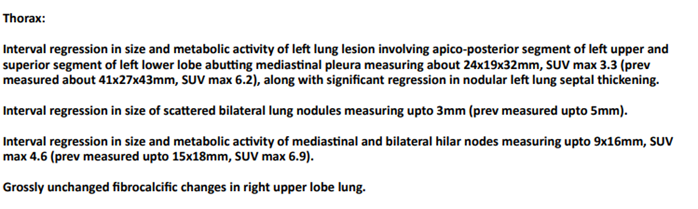
A) September 2025: PET-CT showed a marked response to therapy. The left lung lesion reduced from approximately 41 × 27 × 43 mm (SUVmax 6.2) to 24 × 19 × 32 mm (SUVmax 3.3). Mediastinal/hilar lymph nodes and other previously involved lymph nodes also regressed.
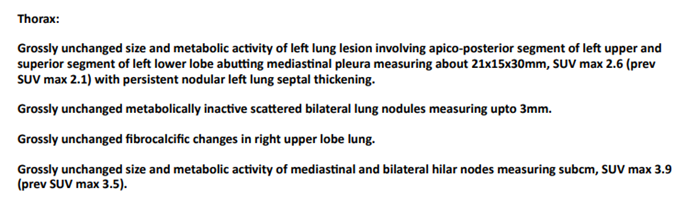
B) January 2026: PET-CT showed further improvement. The left lung lesion decreased to approximately 21 × 15 × 30 mm, with SUVmax decreasing to 2.1. Mediastinal and bilateral hilar lymph nodes also showed further regression. The report concluded that the findings were suggestive of a further favorable response to therapy.
C) April 2026: PET-CT showed stable disease. The left lung lesion remained approximately 21 × 15 × 30 mm, with SUVmax 2.6. The small bilateral lung nodules and mediastinal/hilar lymph nodes were essentially unchanged. No new abnormality was identified.
Current Clinical Status
According to the case information, the patient is currently doing well and is described as clinically stable.
He remains independent and capable of performing his daily activities.
For elderly cancer patients, maintaining functional independence and quality of life can be an important component of long-term ayurvedic cancer care.
Dr. Ravi Gupta and Ayurvedic Cancer Care
Dr. Ravi Gupta, an Ayurveda Cancer Consultant and Panchakarma Specialist, focuses on individualized Ayurvedic approaches for patients dealing with cancer and cancer-treatment-related challenges.
His approach for cancer treatment can include:
1) Ayurvedic herbal medicines
2) Rasayana therapy
3) Balya therapy
4) Panchakarma-based supportive approaches when appropriate
5) Diet and lifestyle guidance
6) Individualized supportive care
The goal is to integrate Ayurvedic principles responsibly into a patient’s overall cancer-care journey while maintaining appropriate medical monitoring and coordination with conventional oncology.
What This Lung Cancer Case Demonstrates
This case highlights the importance of molecular testing, regular imaging and individualized cancer care in patients with lung adenocarcinoma. The identification of an EGFR exon 19 deletion demonstrates the value of genomic testing in appropriately selected patients, while serial PET-CT scans showed a substantial reduction in tumor size and metabolic activity between May 2025 and January 2026, followed by stable findings in April 2026.
The patient’s care involved both conventional oncology treatment and an Ayurvedic treatment plan approach, including herbal medicines, Rasayana Therapy and Balya Therapy. At the latest follow-up, the patient was reported to be clinically stable, independent and able to perform his daily activities. Overall, the case emphasizes the importance of individualized cancer care, taking into consideration the patient’s age, cancer type, molecular profile, treatment history, strength, symptoms and overall health.
Consult Dr. Ravi Gupta for Ayurvedic Cancer Care
If you or your loved one is looking for Ayurvedic treatment for cancer, you can consult Dr. Ravi Gupta, M.D. (Ayurveda), Ayurveda Cancer Consultant and Panchakarma Specialist. Dr. Ravi Gupta provides individualized Ayurvedic care based on the type and stage of cancer, treatment history, overall health and specific patient needs. His approach includes Ayurvedic herbal medicines, Rasayana Therapy, Balya Therapy, diet and lifestyle guidance and other supportive Ayurvedic therapies, depending on the patient’s condition.
For Ayurvedic Cancer Consultation and Treatment:
📞 Call/WhatsApp: +91-9819274611
🌐 Website: www.cancerinayurveda.com