
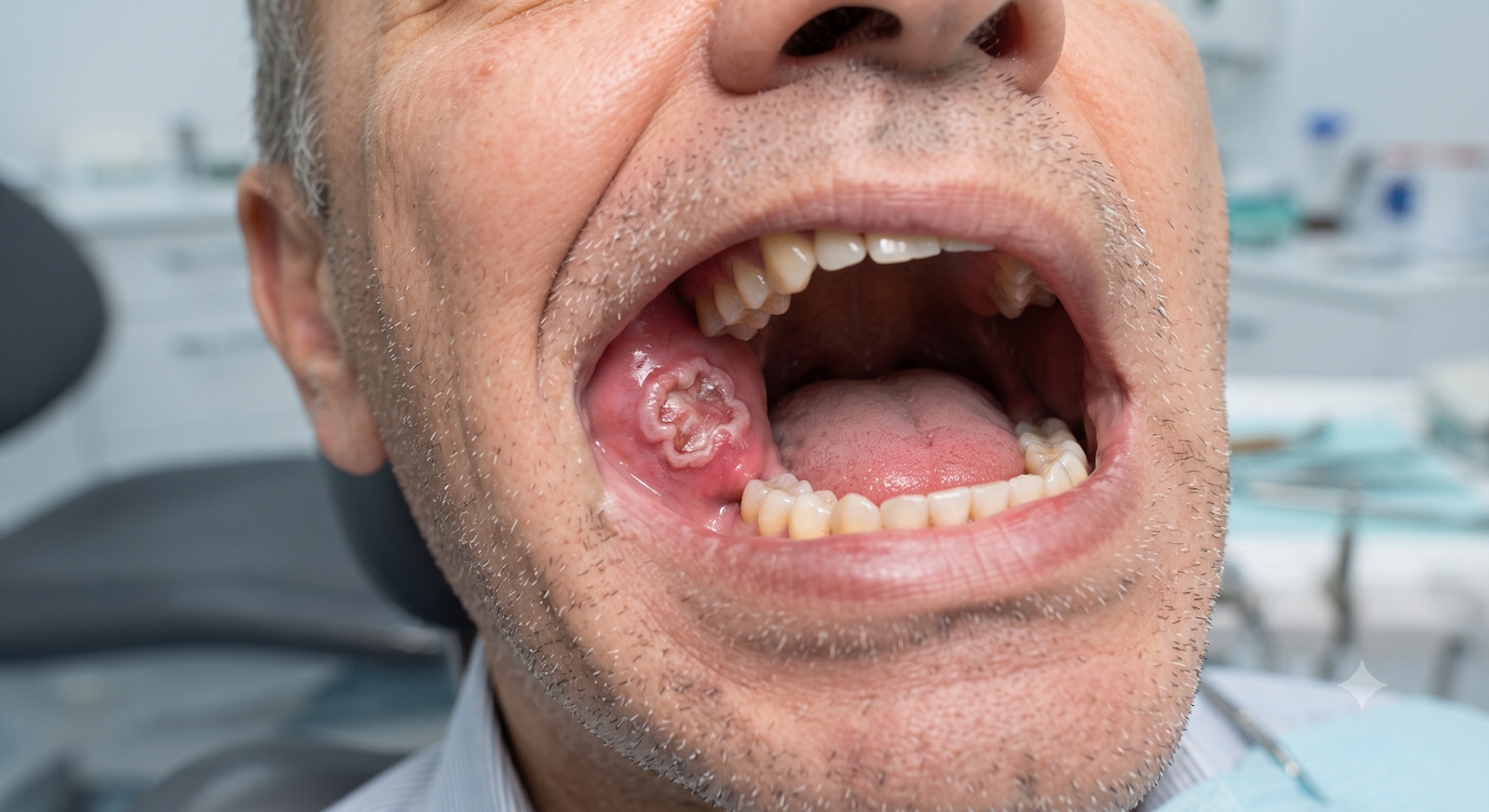
Mouth cancer is one of the most common cancers in India and represents a major public health concern due to the widespread use of tobacco, gutkha, betel nut (areca nut), smoking, and alcohol. India accounts for nearly one-third of the global burden of oral cancer and approximately 141,000 new mouth cancer cases diagnosed every year.
It is the most common cancer among Indian men and is significantly more prevalent in males than females due to higher exposure to tobacco-related risk factors. Despite advances in diagnosis and treatment, it is well known fact that many patients are diagnosed at an advanced stage. It further emphasizes the importance of early detection, regular oral examinations, and public awareness about the harmful effects of tobacco and alcohol.
Causes of Mouth Cancer
Mouth cancer develops when cells in the mouth grow uncontrollably. It is often linked to a combination of lifestyle, environmental, and biological factors.
The most common causes and risk factors include:
a) Tobacco use (cigarettes, cigars, pipes, chewing tobacco, snuff): This is the leading risk factor.
b) Heavy alcohol consumption: Drinking alcohol regularly, especially together with tobacco use, greatly increases the risk.
c) Betel quid (areca nut) chewing: Common in some parts of Asia and a major cause of mouth cancer.
d) Infection with Human papillomavirus infection: HPV-16 – More strongly linked to cancers of the back of the throat but can also contribute to some mouth cancers.
e) Poor diet: Low intake of fruits and vegetables may increase risk of mouth cancer.
f) Chronic irritation: Long-standing irritation from poorly fitting dentures or sharp teeth may contribute, although it is not considered a major cause by itself.
g) Older age and male sex: Most cases occur in people over 50, although younger adults can also be affected.
Dr. Ravi Gupta – Best Ayurvedic Doctor for Treatment of Mouth Cancer
Dr. Ravi Gupta, M.D. (Ayurveda), provides personalized Ayurvedic treatment plans for patients with mouth cancer. The approach focuses on treating mouth cancer, supporting overall health, improving quality of life, and promoting recovery through classical Ayurvedic principles.
His treatment plans include carefully selected herbal formulations, Rasayana therapy, Panchakarma (when appropriate), dietary guidance, and lifestyle recommendations based on each patient’s condition. Patients undergoing surgery, chemotherapy, or radiotherapy can also receive integrative Ayurvedic treatment under professional supervision. Every treatment plan is individualized after a detailed medical evaluation.
Ayurvedic Treatment of Mouth Cancer
In Ayurveda, the treatment of mouth cancer, or mukhagata arbuda, is approached through Shamana (pacification) and Shodhana (detoxification) to address systemic imbalance, and Rasayana (rejuvenation) to bolster immunomodulation and overall vitality. Ayurvedic treatment modalities for mouth cancer includes:
1) Herbal medicines for the treatment of mouth cancer
Ayurvedic herbal medicines are advised based on the patient’s individual constitution (Prakriti), stage of disease, digestive strength (Agni), ongoing medical treatment, and overall health. Ayurvedic herbal medicine can help to support immune function, reduce inflammation, promote tissue healing, improve digestion, and enhance overall quality of life.
They should always be prescribed by a qualified Ayurvedic physician, especially for patients undergoing surgery, chemotherapy, immunotherapy, or radiotherapy.

A) Gandhaka Rasayana in the management of Mouth Cancer
Gandhaka Rasayana is a classical Ayurvedic formulation prepared from purified sulfur (Shuddha Gandhaka) through repeated processing (Bhavana) with various herbal juices and decoctions. Traditionally, gandhaka rasayana is described as a Rasayana medicine that supports tissue nourishment, promotes wound healing, and enhances overall vitality. Gandhaka Rasayana have a role as a Rasayana therapy in an integrative approach to mouth cancer by helping maintain general health, supporting tissue healing, and improving quality of life in selected patients.
Benefits Gandhaka Rasayana in mouth cancer as follows:
a) Antioxidant activity
b) Anti-inflammatory properties
c) Immunomodulatory effects.
d) Potential wound-healing activity.
2) Panchakarma in the management of Mouth Cancer
Panchakarma is one of the most important therapeutic approaches in Ayurveda and is aimed at eliminating accumulated toxins (Ama), balancing the Doshas, improving tissue nourishment (Dhatu Poshana), and enhancing the body’s natural healing capacity. Panchakarma can help to treat mouth cancer, improve quality of life, support recovery, and promote overall well-being of mouth cancer patients.
Role of Panchakarma in Mouth Cancer:
a) It supports detoxification by helping eliminate metabolic waste (Ama) in mouth cancer patients.
b) It balances the aggravated Pitta, Kapha, and Vata Doshas
c) It improves the digestion (Agni) and metabolism in mouth cancer patients.
d) It enhances the immune function and vitality (Ojas).
e) It reduces the inflammation and promoting tissue repair in mouth cancer patients.

A) Gandusha and Kavala (Medicated Oil Holding and Gargling) in the treatment of Mouth Cancer
Gandusha and Kavala are two classical Ayurvedic oral care therapies described in traditional texts for maintaining oral hygiene and further management of diseases affecting the mouth.
Gandusha is an Ayurvedic procedure in which the mouth is completely filled with a medicated liquid (such as herbal oil, medicated ghee, herbal decoction, or medicated milk) and held without movement for a prescribed duration until salivation increases or discomfort is felt. The liquid is then expelled.
Kavala involves taking a smaller quantity of medicated liquid into the mouth and actively swishing or gargling it before spitting it out. Because the liquid is moved around, Kavala is generally easier for patients with reduced mouth opening or oral discomfort.
Benefit of Gandusha and Kavala in the treatment of Mouth Cancer
a) It helps to maintain oral cleanliness.
b) It helps to soothe inflamed mucosa.
c) It promotes healing of healthy tissues.
d) It helps to improve comfort during eating and speaking.
3) Rasayana Therapy in the management of Mouth Cancer
Rasayana Therapy is a specialized branch of Ayurveda focused on rejuvenation, immune enhancement, and tissue regeneration. In the context of mouth cancer (oral cancer), Rasayana therapy plays a supportive and restorative role by improving the body’s resistance against mouth cancer, reducing treatment-related side effects, and enhancing overall quality of life. Key Benefits of Rasayana Therapy as follows:
a) Immunomodulation: Rasayana therapy enhances the body’s natural defense mechanism.
b) Anti-inflammatory action: Rasayana therapy helps to reduce local inflammation in oral tissues.
c) Antioxidant effect: Rasayana therapy neutralizes free radicals involved in cancer progression.
d) Improves healing: Rasayana therapy supports recovery of oral mucosa and ulcers.
Ashwagandha Rasayana in the management of Mouth Cancer
Ashwagandha Rasayana is a rejuvenative (Rasayana) therapy in Ayurveda that utilizes Ashwagandha (Withania somnifera) to enhance vitality, strengthen immunity, promote tissue nourishment, and improve resilience against disease. Traditionally, Ashwagandha is classified as a Balya (strength-promoting), Rasayana (rejuvenative), and Vajikarana (vitality-enhancing) herb.
Contact Dr. Ravi Gupta for Ayurvedic Treatment of Mouth Cancer
If you are looking for personalized Ayurvedic treatment for mouth cancer, consult Dr. Ravi Gupta, M.D. (Ayurveda), an experienced Ayurvedic Cancer Consultant specializing in integrative Ayurvedic cancer care.
Consultations are available both in-person and online for patients from India and around the world. To book an appointment, call or WhatsApp +91-9819274611 / 9967239823 or visit www.cancerinayurveda.com for more information.