About Ayurveda
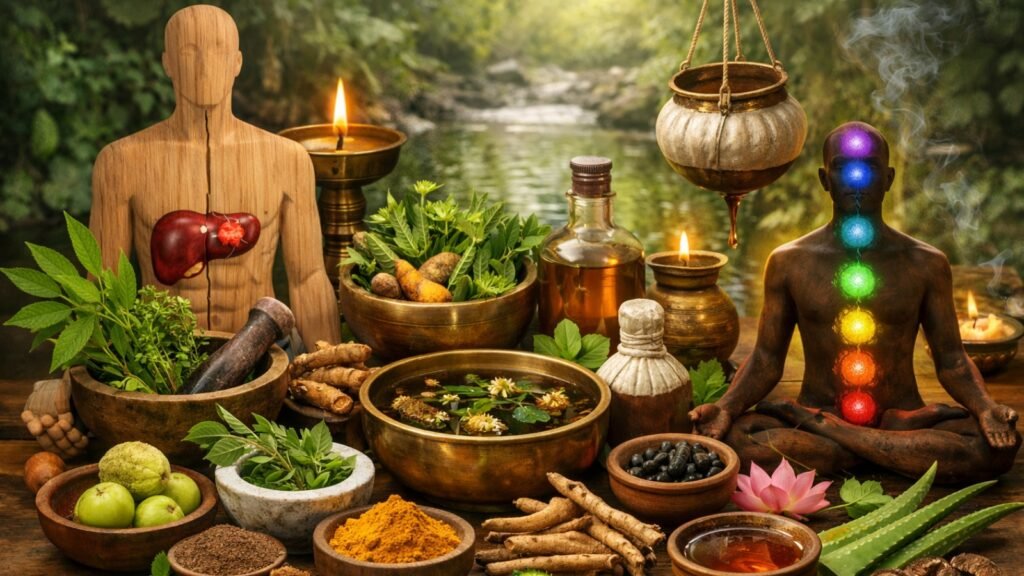
Ayurveda is an ancient system of Indian medicine that has originated more than 3000 years ago. Ayurveda strongly believes and advocates that physical health and mental wellness depend on the delicate balance between mind, body and spirit. To achieve this delicate balance ayurveda preaches different treatment modalities like herbal drugs, exercises, yoga, and many other different modalities. The word Ayurveda is derived from “Ayur” which means life and “Veda” meaning is “Knowledge”. So, popularly ayurveda means “the science of life”. Ayurvedic treatment for Liver Cancer is increasing globally. Ayurveda treatment for liver Cancer is focuses on the entire system.
Ayurveda strongly believes that body is made of 5 different elements:
1) Space (Aakash).
2) Air (Vayu).
3) Fire (Agni).
4) Water (Jala).
5) Earth (Prithivi).
Ayurveda also advocates that the body consists to three different governing principles:
1) Vata.
2) Pitta.
3) Kapha.
These governing principles are called doshas. The unique combination of doshas determine prakriti or nature of an individual. This prakriti can be further defined as
1) Sharirik Prakriti (Physical Nature),
2) Mansik Prakriti (Nature of Mental Status).
Both Sharirik and Mansik Prakriti are unique to an individual. When this three doshas are in harmony and balance it further grant healthy and fruitful life. And when this doshas are vitiated it results in unhappiness and suffering in form of rogas (diseases).
What is Liver?
Liver is a complex, and largest solid organ in the body which carries out various important functions. Liver weighs around 1.4 kgs in adults and is located in the upper right side of the abdomen, just beneath the diaphragm. Liver occupies significant portion of the upper abdomen, and crosses the midline of the body. Liver is further divided into two lobes, the larger right lobe and the smaller left lobe. Smaller left lobe is further divided into two lobes, the lateral and the medial lobes.
Several ligaments hold the liver in place and connects it through different organs. The falciform ligament attaches the liver to anterior abdominal wall, and divides the liver into right and left lobe. The lesser omentum attaches the liver to stomach and coronary ligament attaches the liver to diaphragm. The functional unit of the liver is called lobules, and it is numerous in numbers. Each lobule consist of liver cells called hepatocytes, and is arranged in hexagonal shapes around central vein. Hepatocytes carries out basic metabolic function of the liver.
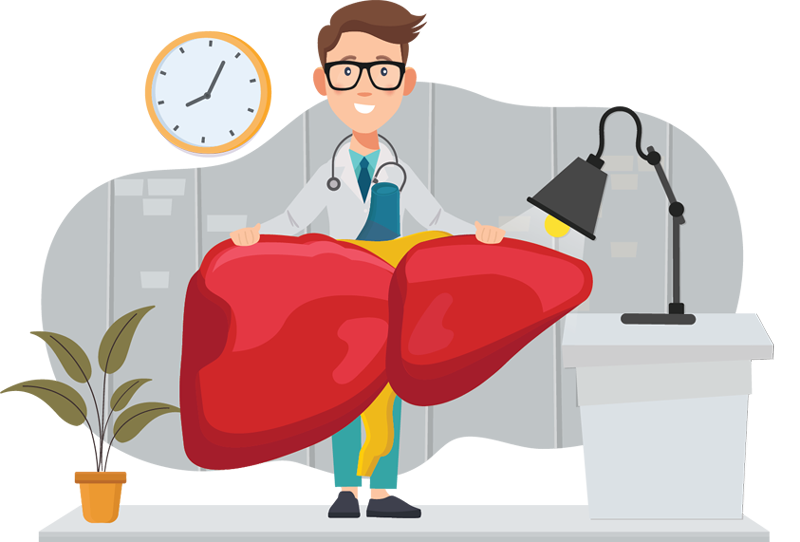
Liver has one of the most unique blood supply called dual blood supply. The oxygenated blood flows to the liver through hepatic artery which is the branch of the celiac trunk and nutrient rich blood flows to the liver through portal veins. The liver produces and secretes bile in the gall bladder. Liver secrete bile into smaller bile ducts, which merges into larger bile duct and is further secreted in to gall bladder.
What is Liver Cancer?
Liver Cancer which is also commonly known as hepatocellular carcinoma (HCC), is a type of cancer that originates in the cells of the liver and is the most common form primary liver carcinoma. Primary carcinoma of the liver means the cancer that starts from the liver itself rather than spreading from another part of the body.
Liver cancer occurs when normal liver cells accumulates enough genetic mutations that further leads to its uncontrolled growth and formation of tumor. Carcinogenic mutations in the liver cells is caused by multiple factors which includes: 1) Chronic Viral Hepatitis (especially hepatitis B and C). 2) Cirrhosis of the liver. 3) Non-Alcoholic Fatty Liver Disease (NAFLD) or Non-Alcoholic Steatohepatitis (NASH). 4) Alcohol Abuse. 5) Exposure to Alfa toxins (toxic substances that is produced by certain molds). 6) Inherited liver disease (Inherited genetic mutations).

Liver cancer is diagnosed through combination of modalities like physical examinations, imaging tests (such as Ultrasound, Computed Tomography Scan, and MRI), and the blood investigations. Blood investigations includes to check the liver function tests and tumors markers. Biopsy and further histopathology studies of the mass can be confirmatory in studies of liver cancer.
Liver Cancer Statistics
Liver cancer is one of the most significant health concern in India, and globally too. New cases, with increased numbers, every coming year is diagnosed globally. Below is some general statistics over liver cancer:
1) Incidence:
Liver cancer is the sixth most common cancer diagnosed globally and is the third leading cause of cancer related death in the world, just lagging behind lung and colo-rectal cancer. It is estimated that over 0.9 million new cases of liver cancer will be diagnosed in year 2023.
2) Mortality:
Liver cancer is a disease with high mortality, and it will cause approximately 0.8 million death globally in year 2023. In United States, approximately more than 29, 000 people will die from Liver Cancer in year 2023. The five year survival from liver cancer is 17%.
3) Gender:
Liver cancer is fifth leading cause of cancer related deaths in men and seventh leading cause of cancer related deaths in women.
4) Type of Liver Cancer:
The most common type of liver cancer is hepatocellular carcinoma (HCC), and it accounts for approximately 75 – 85% of all liver cancer cases diagnosed globally. Other types of liver cancer Hepatoblastoma which mostly affects children’s and intrahepatic cholangiocarcinoma.
5) Risk Factors:
Several factors are responsible to increased risk of liver cancer which includes chronic infection with Hepatitis B Virus (HBV), and or Hepatitis C Virus (HCV). Increased of liver cancer is even due to heavy alcohol consumption and its further complications, obesity, Non-Alcoholic Fatty Liver Disease (NAFLD), Non-Alcoholic Steateo-Hepatitis (NASH), exposure to aflatoxin etc. Inherited liver disease like hemochromatosis can also contribute to increased incidence of liver cancer.
6) Geographical Variation:
Increased incidence of liver cancer vary across different region of the world and is found to be in increased incidence in East Asia, sub-Saharan Africa, and Melanesia. Increased incidence in this area is also primarily due to chronic hepatitis b and c infections.
7) Age:
The incidence of liver cancer increases with age and the average age of diagnosis is 65 year old, and men are more likely to be diagnosed with liver cancer than women.
Liver Cancer Causes
Liver cancer have multiple causes ranging from chronic viral infections and underlying hepatic diseases being one of the multiple risk factor. Here is some primary causes of liver cancer: –
1) Chronic Hepatitis B Virus (HBV): Infection:
Chronic infection of HBV is one of the leading cause of liver cancer worldwide, and in India too. Hepatitis B virus causes chronic inflammation, and further damage to liver cells leading to development of cancer. Hepatitis B Virus is transmitted through exposure to blood or other bodily fluids of infected individual, unprotected sexual contact, sharing needles with infected individual, or direct transmission from mother to child during birth.
2) Chronic Hepatitis C Virus (HCV):
Chronic Hepatitis C Virus is another significant concern in increased risk for of liver cancer. Hepatitis C Virus Infection causes chronic inflammation of the liver and cirrhosis (Scarring) which further result in development of liver cancer in some of the infected individuals. Hepatitis C Virus (HCV) is transmitted primarily due to transfusion of blood of a person who is infected with Hepatitis C into another normal person, exposure to blood of infected individual, and sharing needles of infected individuals.
3) Cirrhosis:
Liver Cirrhosis refers to advanced stage of fibrotic scarring of the liver tissue due to multiple causes like chronic viral infections, chronic alcoholism, Non-Alcoholic Fatty Liver Disease (NAFLD), Non-Alcoholic Steateo-Hepatitis (NASH) etc. Development of cirrhosis in the liver is one of the significant contributor in increased risk of liver cancer. Cirrhosis of liver can lead in genetic mutations and further to development of cancer.
4) Alcohol:
Related Liver Cancer: Consumption of alcohol for long time and that too in excessive amounts can lead in development of liver cirrhosis, and it further increases the risk for liver cancer. Individuals already suffering with chronic hepatitis b infection, hepatitis c infections, Non-Alcoholic Fatty Liver Disease (NAFLD), and or Non-Alcoholic Steateo-Hepatitis (NASH) alcohol abuse can have a compounding effect in the risk of development of liver cancer.
शोणितवहानां स्रोतसां यकृन्मूलं प्लीहा च. Charak Vimanasthana 5/7
The origin or base of Rakthavaha Strotas in Yakrut (Liver) and Pleeha (Spleen).
विदाहीन्यन्नपानानि स्निग्धोष्णानि द्रवाणि च| रक्तवाहीनि दुष्यन्ति भजतां चातपानलौ|| Charak Vimansthana 5/14
Treatment of Liver Cancer in Ayurveda
1) Oral Medications
2) Panchakarma.
Oral Medications
1)Phyllanthus niruri (Bhumiamlaki) in Liver Cancer
Phyllanthus niruri (Bhumiamlaki) is a small herbaceous plant which is native to tropical region of Amazon rainforest, the Caribbean, and most prominently in India too. Traditionally, Phyllanthus niruri (Bhumiamlaki) has been used as a Ayurvedic Medicine since long time and has been also widely mentioned in folklore medicine. Phyllanthus niruri (Bhumiamlaki) typically grows to a height of a 1 meter, and the entire plant, including leaves, stems, barks and roots is used for ayurvedic medicinal purposes.
1) Hepatoprotective Activities: Phyllanthus niruri (Bhumiamlaki) has proven hepatoprotective activities and protect liver from damage due to different conditions. It supports liver function, and the management of different liver related conditions including primary and secondary liver cancer.
2) Antioxidant and anti-inflammatory effects: Phyllanthus niruri (Bhumiamlaki) has good antioxidant and anti-inflammatory properties. This properties prove beneficial in liver cancer patients.
3) Immune system support: Phyllanthus niruri (Bhumiamlaki) has a good immuno-modulatory effects, and by doing so it helps in increasing susceptibility of liver cancer cells to immune system.
4) Anti-Cancer activities: Phyllanthus niruri (Bhumiamlaki) has several bioactive compounds which has anti-cancer activities. It induces cancer cell deaths through apoptosis, and inhibits growth of the cancer cells thereby preventing the proliferation and metastatis of the cancer.
Bhumiamlaki Ghanvati (भूमि आमलकी घनवटी) in Liver Cancer
Panchang (five parts – leaves, stem, bark, roots and flowers) of Phyllanthus niruri (Bhumiamlaki) is washed clean with water and is cooked with 16 times of water. When half amount of water is remaining the mixture is filtered through cotton cloth, and the solid part is separated and discarded.
The remaining liquid is boiled again till a thick paste like stage is attained, and further cooking is stopped. Now the thick paste is further sundried and tablets or vati is prepared from it. This Bhumiamlaki Ghanvati (भूमि आमलकी घनवटी) proves beneficial in primary or secondary liver cancer patients.
2)Swertia Chirayita (Kirat Tiktha) in Liver Cancer
Swertia chirayita (Kirat Tiktha) which is also commonly known as Chirayita, is a medicinal plant that is commonly found in Himalayan region, including Nepal, Bhutan, and in India too. Chirayita is widely used since ancient times in Ayurvedic and Tibetan system of medicines, and has various other health benefits. Swertia chirayita (Kirat Tiktha) is commonly known as bitter tonic.
Entire plant of Swertia chirayita (Kirat Tiktha) is used including stem, leaves, and the roots for different medicinal purposes, and in liver cancer. Swertia chirayita (Kirat Tiktha) contains several bioactive compounds, including swertiamarin, amarogentinin, mangiferin, and xanthones, and it contributes to its vast medicinal properties.
Swertia chirayita (Kirat Tiktha) is commonly used to treat various disorders like fever, digestive issues, and various liver diseases. It is also known to promote and support immune system. Swertia chirayita (Kirat Tiktha) also has hepatoprotective, anti-inflammatory, anti-pyretic, and anti-microbial properties, so it proves very beneficial in liver cancer patients.
Swertia chirayita (Kirat Tiktha) exhibits anti-cancer effects by inhibiting the proliferation of the liver cancer cells and inducing apoptosis (programmed cell death). Swertia chirayita (Kirat Tiktha) have been found effective in restricting the growth of primary liver cancer. Bioactive compounds in Swertia chirayita (Kirat Tiktha) such as swertiamarin and amarogentinin shows hepatoprotective properties, and it prevent further liver damage.
Kirat Tiktha Ghanvati (किराततिक्त घनवटी) in Liver Cancer Patients
The method of preparation is same as mentioned in Bhumi Amlaki Ghanvati. Here also Panchang (five parts – leaves, stem, bark, roots and flowers) of Swertia chirayita (Kirat Tiktha) is taken and Ghanvati is prepared. This Kirat Tiktha Ghanvati (किराततिक्त घनवटी) also proves beneficial in primary or secondary liver cancer patients.
3) Tamra Bhasma (ताम्र भस्म) in Liver Cancer patients
Tamra Bhasma is also called incinerated copper, and is one of the most important medication for Ayurvedic Practitioners. There are several different methods of preparation of Tamra Bhasma mentioned in Ayurvedic Texts. Tamra Bhasma or incinerated copper is one of the most important metallic bhasmas mentioned in Ayurveda and is used in treatment of many diseases.
Tamra Bhasma is prepared by following the procedure of Shodhana, Marana and Amritikarana as mentioned in different Ayurvedic texts which is done over Copper (Tamra). Then processed copper (tamra) is taken for puta or incineration under controlled environment to get good Tamra Bhasma. Generally three such puta or incineration procedure is done or number can vary depending on the text which is being followed. Puta or controlled incineration destroys the impurities in Tamra, and increases its bioavailability.
Tamra Bhasma can be used in multiple disorders like Fever (Jwara), Cachexia (Rajayakshma), Liver and Spleen Disorders (Yakrut Pleeha Roga), Different Eye disorders (Various Netra Roga), Vatavyadhi and Skin disorders (Kustha Roga). Tamra Bhasma is believed to have anti-inflammatory, anti-oxidant and immuno-modulatory properties.
Tamra Bhasma has proved its potency against liver cancer and induces apoptosis in cancer cells. Tamra Bhasma induces apoptosis by regulation of p53 gene, activation of BAX and inhibition of Bcl – 2 protein induced apoptosis.
Purgation or Virechana Karma (विरेचन कर्म) in Liver Cancer Patients
Virechana Karma is one of the purification therapies mentioned under Panchakarma in Ayurveda. Virechana Karma mainly focusses on eliminating excessive dustha doshas mainly pitta dosha and toxins from the body. Virechana Karma involves administration of purgative medications to induce controlled and gentle purgation which eventually stops on its own.
Virechana Karma involves poorva karma or preparatory phase in which oleation of the patient is done through medicated ghee which help in liquefying the dustha doshas and transporting the toxins toward gastrointestinal tracts for further elimination through administration of purgative drugs.
Virechana Karma helps in balancing Pitta Dosha and improving digestion of the liver cancer patients. It even enhances metabolism, and promote mental and physical well-being of liver cancer patients.
About Team ‘Cancer In Ayurveda’
Team “Cancer In Ayurveda” is dedicated group of researcher and practitioners who have come together with aim of exploring the potential of Ayurveda in Cancer management, and further benefitting the cancer patients. Team “Cancer In Ayurveda” strongly believes in principles of Ayurveda, an ancient holistic healing system and further inculcates those principles in treatment and management of Cancer patients.
We at Team “Cancer In Ayurveda” also have a shared dream of raising the awareness of the role of Ayurveda in management of Cancer Disease among modern healthcare professionals and general public. We at Team “Cancer In Ayurveda” also strive to restore balance and harmony among doshas in the body of the cancer patients.
Ayurvedic Liver Cancer Treatment: Holistic Ayurveda for Liver Cancer Recovery and Management
Understanding Liver Cancer Through Ayurveda
- Restoring dosha balance
- Supporting liver metabolism
- Enhancing digestion and detoxification
- Strengthening immunity and vitality
- Improving mental and emotional stability

Role of Ayurveda in Liver Cancer Care
- Improved appetite and digestion
- Reduced fatigue and weakness
- Better tolerance to ongoing medical treatments
- Support for liver function
- Enhanced emotional balance and stress reduction
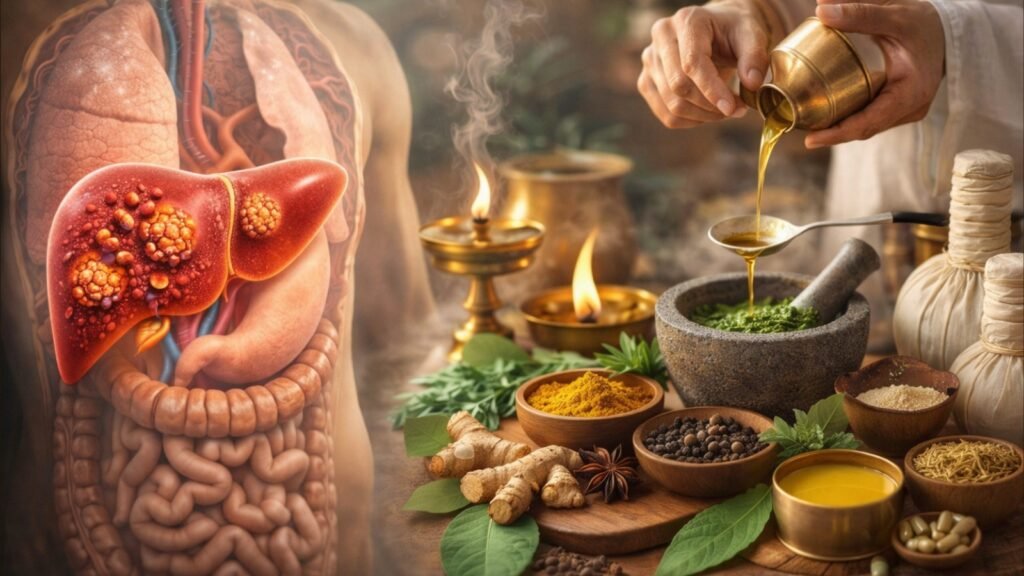
Natural Ayurvedic Remedies for Liver Cancer Support
1. Bhumiamalaki (Phyllanthus niruri)
2. Kirat Tikta (Swertia chirayita)
3. Classical Ayurvedic Preparations
Panchakarma and Detoxification Support
Diet and Lifestyle in Ayurvedic Liver Cancer Care
- Warm, freshly cooked meals
- Light and easily digestible foods
- Avoidance of alcohol and processed foods
- Reduced intake of excessively oily or spicy meals
- Adequate hydration
- Gentle yoga and breathing practices
- Stress management and emotional support

Integrative Care: Ayurveda Alongside Modern Treatment
Why Choose an Ayurvedic Supportive Approach?
- Enhancing quality of life
- Supporting natural healing capacity
- Reducing treatment-related discomfort
- Promoting physical and mental balance
- Encouraging sustainable recovery habits